
Over the years news about the medicinal use of cannabis in the media have come and gone.
Last month, October 17th 2018 to be exact, Canada stated that recreational use of Cannabis would no longer violate criminal law. (source) But they had already cleared it for medicinal use back in 2001!
This month in the UK, where I currently reside, Cannabis was approved for medicinal use. The UK under pressure from campaigners has taken a step closer to policies seen in Holland, Portugal, the majority of the US and Canada as mentioned above.
Campaigners asked how the UK Government could argue against banning the use of Cannabis, following several high profile cases where it has been shown to alleviate symptoms of epilepsy in children, when the UK was also one of the Worlds biggest exports of the drug.
The effects of Cannabis are said to help not just epilepsy, but also MS, cancer and other serious conditions.
Can Cannabis help Ankylosing Spondylitis?
Well not every case or every person is the same, so I can only answer for myself as there is currently no large scale research on the matter.
Cannabis without prescription mean you’ll be shopping for CBD based products. CBD oil or capsules for example. These are non-psychoactive, so you won’t get ‘high’ from taking these supplements. I say supplements as proper medicines are rarely available to buy off the shelf or over the internet without some kind of regulation.
CBD is the acronym for Cannabidol. Cannabidiol is a naturally occurring cannabinoid constituent of cannabis. It was discovered in 1940 and initially thought not to be pharmaceutically active. It is one of at least 113 cannabinoids identified in hemp plants, accounting for up to 40% of the plant’s extract. (source)
I found this CBD product for sale quite widely on the on the internet.
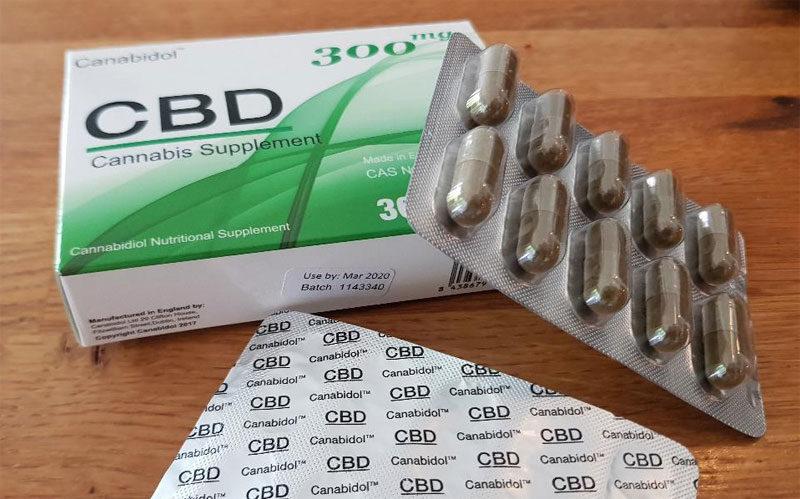
Product information for Canabidol can be found here on the manufacturer’s website.
I took the suggested 2 pills a day. One in the morning and one in the evening with or after a meal.
Over this period I had some real peaks in pain in my hips, arms, kidney area and back and I didn’t really feel as if the CBD capsules were having an effect that I could register.
The product has reviews saying it worked for them, but why not for me?
This prompted me to look into the product and CBD’s in general a little further and I found at least one reason why some CBD products don’t work.
Firstly I took up Canbidol’s invitation on their packaging to view lab test results on their website.
https://canabidol.com/seemyresults
It’s a web page with a list of all their products with batch data and in the final column the ‘CBDmg data’.
I scrolled down to the product I believe I had been trying – ‘Canabidol™ – 300mg CBDa Capsules’ and noticed first off, it said ‘CBDa’, which isn’t on the box. Then secondly that it was a recent test at least, that of October 18th 2018, but in the CBDmg data column it says ‘Not Detected’!
For every other product on that page there is a reading of a few hundred mg, so I clicked on the report for more information. The results are below.
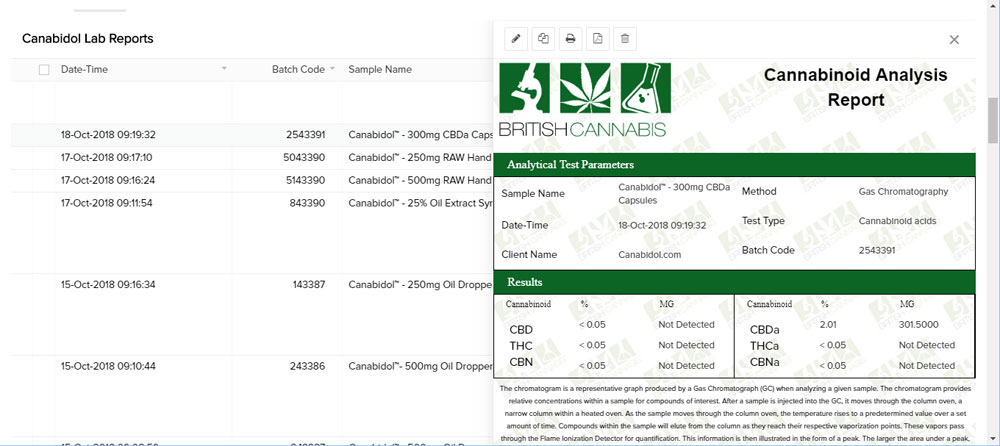
Cannabis supplement (CBD) from Canabidol test results October 2018 – source: https://canabidol.com/seemyresultsYou can see the level of CBD is ‘Not Detected’, however the level of CBDa is 301.5mg, which lead me to ask…
What’s the difference between CBD and CBDa?
CBDa is the acid precursor to CDB. Cannabis naturally contains CBDa, however CBDa is considered to be inactive or non-phycoactive. There is not a lot of information or test results available about this form of Cannabidiol. Whereas CBD has proven results and this is where the bulk of research is focused.
So it appears from what I’ve read that the CBD capsules I bought only contain the supposedly inactive form of cannabidiol, which is possibly why it had little or no effect on me.
How does CBDa become CBD?
The process required to convert CBDa to the more active CBD is called Decarboxylation.
source: https://en.wikipedia.org/wiki/Decarboxylation
‘Decarboxylation is a chemical process that removes a carboxyl group and releases a carbon dioxide’ – I know what you’re thinking. What does that mean?
Essentially the process heating the CBDa or leaving it to dry out converts it to CBD. That is what happens when Cannabis is smoked. According to this website, decarboxylation occurs in cannabis at around 100°C after 30-45minutes of exposure.
The odd thing is, the box for the product says on the reverse:
‘A Canabiodiol (CBD) capsule designed for oral use. Containing all the phytocannabinoids, terpenoids, essential oils and othe compounds found in the cannabis plant. Decarboxylated for maximum CBD potency.’
So are the capsules decarboxylated or not?
I’m going to have to write to the manufacturers and find out!
The reply will be posted as soon as I get one. In the mean time check out more Cannabidiol CBD products here
